
Why the future of revenue isn't just about hiring more salespeople—it's about building a technical architecture that scales trust.
Summary
For decades, scaling revenue meant scaling headcount. If you wanted to double sales, you hired double the sales representatives. Today, that equation is breaking. A new discipline is emerging at the intersection of revenue and code: Go-To-Market (GTM) Engineering. This article explores how forward-thinking companies are replacing manual prospecting with AI agents, treating the sales process as a product experience, and using deep technographic data to predict buying intent. By shifting from a "brute force" model to an engineered architecture, organizations are achieving 10x leverage, where a single engineer can outperform a traditional team of SDRs. We analyze the rise of the GTM Engineer, the psychology of risk-averse B2B buying, and why the next generation of sales leaders will look more like product managers than closers.
Key Takeaways; TLDR;
- The GTM Engineer Role: A new hybrid role combining technical skills (coding, APIs) with sales intuition is replacing traditional SDR teams, using AI agents to automate research and outreach.
- Efficiency as Leverage: AI allows companies to maintain flat headcount while scaling output; one GTM engineer can often manage the workload of 10 traditional SDRs.
- Sales as a Product: The buying journey should be designed with the same rigor as user experience (UX). Every touchpoint must deliver standalone value, regardless of whether a sale occurs.
- Technographic Segmentation: Moving beyond basic firmographics (size, revenue) to behavioral signals—like a website's Core Web Vitals (CrUX) score—can predict propensity to buy with far greater accuracy.
- Risk Over Gain: 80% of B2B buying decisions are driven by risk aversion (avoiding career damage) rather than the pursuit of upside. Sales narratives must pivot from "art of the possible" to "derisking the future."
- The Feedback Loop: The best sales organizations function as an extension of R&D, treating objections as product bugs and feeding high-fidelity signal back to engineering. For most of the history of software, "Go-To-Market" (GTM) was synonymous with "hiring." If a company wanted to grow 50% next year, the math was simple: hire 50% more sales reps, buy 50% more leads, and hope the unit economics held together. It was a brute-force equation, reliant on human charisma and sheer volume of activity.
That era is ending. We are witnessing the transition of sales from an art form to an engineering discipline.
The catalyst is not just the arrival of Generative AI, but a fundamental rethinking of the commercial architecture. Leading organizations are no longer just staffing sales teams; they are building Go-To-Market Engineering functions. These teams treat revenue generation as a systems problem, where code, data, and agents replace the manual drudgery of the past. The result is not just efficiency, but leverage—the ability to decouple revenue growth from headcount growth.
The Rise of the Go-To-Market Engineer
The traditional Sales Development Representative (SDR) model is broken. The job—spending hours researching prospects, copy-pasting emails, and navigating phone trees—is grueling, has high turnover, and is increasingly ineffective in a noisy world.
Enter the GTM Engineer.
This is a new, hybrid professional who sits at the intersection of revenue operations, data science, and software engineering. Unlike a traditional RevOps role, which might focus on configuring Salesforce or managing territory assignments, the GTM Engineer builds proprietary software to automate the revenue engine. They write code to scrape public data, build AI agents that personalize outreach at scale, and architect systems that "self-heal" when data goes stale.
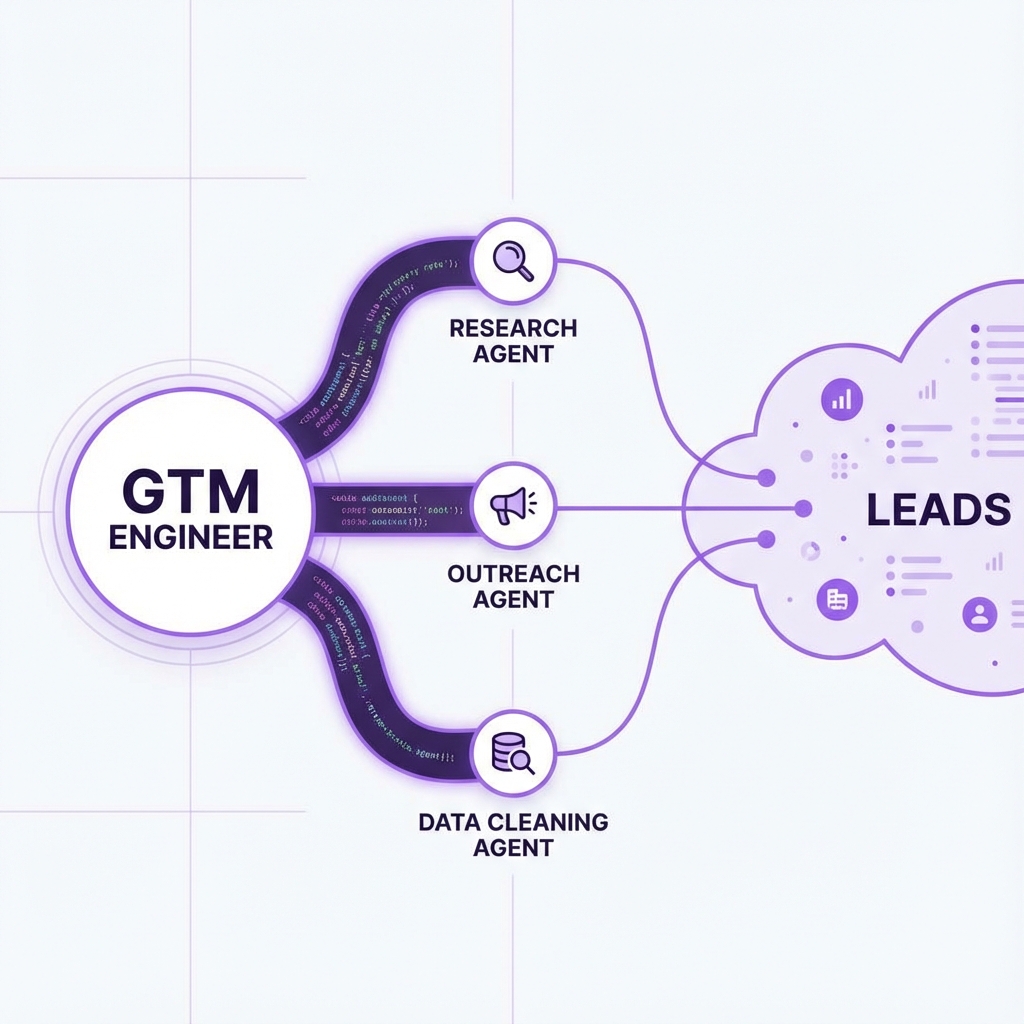
The New Org Chart: A single GTM Engineer orchestrates a fleet of specialized AI agents, replacing the manual workload of traditional SDR teams.
From Rote Tasks to Agent Orchestration
The primary mandate of the GTM Engineer is to identify every deterministic workflow in the sales process and replace it with an agent.
Consider the workflow of an inbound lead. In a traditional org, a human SDR receives a notification, looks up the company on LinkedIn, checks their tech stack, reads recent news, and drafts an email. A GTM Engineer automates this entire chain. They might build a "Lead Agent" that:
- Ingests the lead and enriches it with third-party data.
- Scrapes the prospect's website to understand their business model.
- Determines qualification based on complex logic (e.g., "Is this a marketplace model? If yes, route to the Connect team").
- Drafts a personalized response referencing specific attributes found during the research.
The human role shifts from doing the work to supervising the agent—a "human-in-the-loop" model. This shift allows a single person to handle the volume of ten, transforming the unit economics of customer acquisition. The goal is not to remove humans from the loop entirely but to elevate them. When a salesperson finally speaks to a prospect, they are armed with deep, pre-computed context, allowing them to skip the interrogation and move straight to consulting.
The Sales Process as a User Experience
If you accept that GTM is an engineering problem, it follows that the sales process itself is a product. It has users (prospects), it has a user interface (calls, emails, decks), and it has a "churn" rate (lost deals).
Product-minded sales leaders obsess over the "UX" of being sold to. In a commoditized market where feature sets often converge, the experience of the sale becomes a primary differentiator. If a prospect feels interrogated by a "discovery call" that consists of 20 rapid-fire questions, the experience is high-friction.
The "Whiteboard" Standard
Contrast this with a "whiteboarding" approach. Instead of asking, "What is your budget?" and "Who is the decision maker?", a modern sales process might begin with a collaborative session to map out the prospect's current architecture.
This approach serves two purposes:
- Value Creation: The prospect leaves the meeting with a clearer understanding of their own systems, regardless of whether they buy. The interaction itself provided utility.
- Deep Discovery: The seller learns far more about the technical reality and pain points by co-creating a diagram than they ever would have through a questionnaire.
Treating GTM as a product also means debugging it like one. Advanced teams are now deploying "Loss Bots"—agents that analyze the transcripts, emails, and Slack channels associated with lost deals. These agents often reveal that the stated reason for loss (e.g., "price") differs from the actual reason (e.g., "never engaged the economic buyer"). By treating lost deals as "bugs" in the GTM product, organizations can patch their process in real-time.

Experience vs. Transaction: Moving from checklist-based discovery to collaborative problem solving creates value before the contract is signed.
Precision Segmentation: Beyond Small, Medium, Large
Historically, segmentation was a blunt instrument: Small Business, Mid-Market, and Enterprise. These buckets, usually defined by employee count or revenue, are often poor proxies for buying intent or product fit.
A 50-person startup running a high-traffic AI application has more in common with a Fortune 500 media company than with a 50-person local law firm.
Modern GTM strategies rely on technographic and behavioral segmentation. This involves building a multi-dimensional view of the market based on data that correlates with value.
- Traffic Volume & Quality: For infrastructure companies, a metric like the Chrome User Experience Report (CrUX) score—which measures real-world site performance—can be a leading indicator. A company with high traffic but poor performance scores is an ideal target for optimization tools.
- Tech Stack Composition: Knowing a prospect uses a specific combination of technologies (e.g., Next.js + Stripe + Contentful) can trigger highly specific playbooks.
- Growth Velocity: In consumption-based models, a small company growing 200% year-over-year is often a more valuable target than a stagnant enterprise.
By mapping these attributes on an X/Y axis (e.g., Growth Potential vs. Current Spend), companies can allocate expensive human sales resources only where they add the most marginal value, leaving lower-propensity segments to automated or self-serve motions.
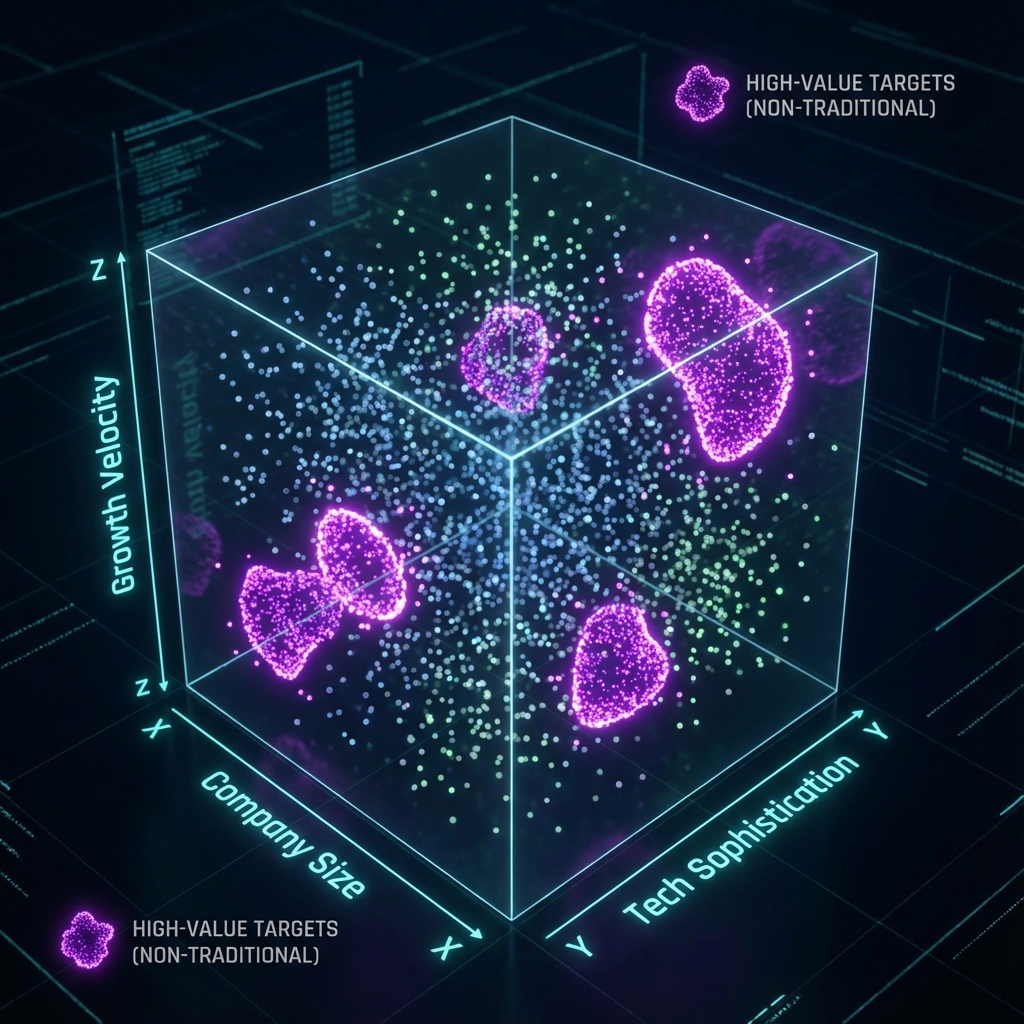
Multi-Dimensional Segmentation: Modern GTM strategies use technographic and behavioral signals to find high-value prospects that traditional firmographics miss.
The Cultural API Between Sales and Engineering
Perhaps the most critical shift in modern GTM is cultural. In many organizations, Sales and Engineering view each other with suspicion. Sales sees Engineering as slow; Engineering sees Sales as "coin-operated" and technically shallow.
The GTM Engineer bridges this gap. Because they speak the language of APIs and pull requests, they gain credibility with the product team. Furthermore, the best sales organizations today position themselves as an extension of R&D.
Sales teams speak to more customers in a week than product managers might in a month. If this qualitative data is rigorously captured and synthesized, Sales becomes the primary source of market signal. The litmus test for a modern sales rep is simple: if you put them in a room with engineers, it should take ten minutes before the engineers realize they aren't speaking to a Product Manager. They must understand the "physics" of the product, not just the pricing sheet.
Conclusion: The Scientific Method of Sales
The era of the "rainmaker"—the lone wolf salesperson who succeeds through intuition and rolodex—is fading. It is being replaced by a scientific approach where hypotheses are tested, workflows are codified in software, and efficiency is engineered.
This does not mean the end of the human salesperson. On the contrary, it elevates the human role. By offloading the robotic tasks of research, data entry, and basic qualification to agents, humans are freed to do what they do best: build trust, navigate complex organizational politics, and manage the emotional psychology of risk.
In B2B sales, 80% of buying decisions are driven by the desire to avoid pain or risk, not to achieve gain . No AI agent can look a CIO in the eye and give them the confidence that a multi-million dollar migration won't cost them their job. That remains a deeply human function. But for everything leading up to that moment, there is now code.
I take on a small number of AI insights projects (think product or market research) each quarter. If you are working on something meaningful, lets talk. Subscribe or comment if this added value.
Appendices
Glossary
- GTM Engineer: A hybrid role combining software engineering and sales operations, responsible for building internal tools, agents, and automations to scale revenue processes.
- Technographic Segmentation: A method of segmenting markets based on the technology stack and digital attributes (e.g., website performance, software usage) of a company rather than just size or revenue.
- CrUX (Chrome User Experience Report): A public dataset from Google that measures how real-world Chrome users experience destinations on the web, often used as a proxy for a company's technical maturity or need for optimization.
Contrarian Views
- The Human Touch Paradox: While automation scales efficiency, over-reliance on agents for outbound can lead to 'spam fatigue,' potentially damaging brand reputation if not monitored by humans.
- Build vs. Buy: While the article advocates for building internal agents, smaller companies may find the maintenance burden of proprietary GTM software outweighs the benefits compared to off-the-shelf SaaS tools.
Limitations
- Data Dependency: The 'GTM Engineer' model relies heavily on the availability of high-quality, enriched data. In industries with poor digital footprints (e.g., manufacturing, construction), this approach is less effective.
- Talent Scarcity: Finding individuals who possess both production-level coding skills and deep sales intuition is currently extremely difficult.
Further Reading
- The Challenger Sale - https://www.amazon.com/Challenger-Sale-Control-Customer-Conversation/dp/1591844355
- Google CrUX Documentation - https://developer.chrome.com/docs/crux
References
- Tapping into the emotions behind B2B buying decisions - Product Marketing Alliance (org, 2024-11-08) https://www.productmarketingalliance.com/tapping-into-the-emotions-behind-b2b-buying-decisions/ -> Supports the claim that B2B buyers are motivated primarily by risk aversion and pain avoidance.
- The Rise of the GTM Engineer - Full Umbrella (news, 2025-02-04) https://full-umbrella.com/blog/rise-of-gtm-engineer -> Defines the emerging role of the GTM Engineer and their responsibilities in automation.
- Chrome User Experience Report (CrUX) - Google Developers (documentation, 2024-01-01) https://developer.chrome.com/docs/crux -> Explains the CrUX dataset used for technographic segmentation.
- AI Agents in Sales Development - MarketsandMarkets (whitepaper, 2025-08-22) https://www.marketsandmarkets.com/industry-practice/sales-marketing/ai-agents-sales-development -> Provides statistics on productivity gains from AI agents in sales.
- Mastering the Art of Go-To-Market - Lenny's Podcast (talk, 2024-10-01) https://www.lennysnewsletter.com/p/mastering-go-to-market-jeanne-grosser -> Primary source for the concepts of GTM Engineering and Vercel's specific strategies.
Recommended Resources
- Signal and Intent: A publication that decodes the timeless human intent behind today's technological signal.
- Thesis Strategies: Strategic research excellence — delivering consulting-grade qualitative synthesis for M&A and due diligence at AI speed.
- Blue Lens Research: AI-powered patient research platform for healthcare, ensuring compliance and deep, actionable insights.
- Outcomes Atlas: Your Atlas to Outcomes — mapping impact and gathering beneficiary feedback for nonprofits to scale without adding staff.
- Qualz.ai: Transforming qualitative research with an AI co-pilot designed to streamline data collection and analysis.