With the White House's 'Genesis Mission' and Anthropic's self-improving Claude 4.5, we have officially entered the era of industrialized discovery.
Summary
As 2025 draws to a close, two simultaneous events have signaled a definitive shift in the trajectory of human progress: the White House's launch of the Genesis Mission—a 'Manhattan Project' for AI-driven scientific discovery—and the release of Claude Opus 4.5, a model capable of recursive self-improvement. This article argues that we have moved beyond the era of generative chatbots into the age of industrialized discovery, where scientific advancement is no longer constrained by human cognition but by available compute and energy. We explore the convergence of federal data sovereignty, next-generation silicon (Google's Ironwood TPU), and the plummeting cost of intelligence. By reframing basic science as a compute problem, humanity is poised to double its scientific output in a decade, though this transition demands a radical rethinking of economic value, labor, and the physical infrastructure—from rural data centers to lunar launch pads—required to sustain it.
Key Takeaways; TLDR;
- The Genesis Mission redefines US science policy, treating federal datasets and supercomputers as a unified 'AI factory' to accelerate breakthroughs in fusion, biotech, and quantum.
- Claude Opus 4.5 demonstrates a critical threshold: AI that outperforms human engineers and uses 76% fewer tokens, signaling the start of an economic 'inner loop' of recursive improvement.
- Compute is the New Oil: Google's Ironwood TPU and Amazon's 1.3GW data center investments illustrate the physical 'tiling of the earth' with infrastructure.
- The End of Scarcity Economics: As intelligence becomes a variable cost approaching zero, traditional labor markets face disruption, necessitating new models like Universal Basic Compute or Equity.
- High-Bandwidth BCI: Paradromics' success in sheep and human trials suggests we are nearing the 'Ray Kurzweil' timeline for high-bandwidth brain-computer interfaces by the 2030s. History rarely announces its turning points with a single bang; usually, it is a convergence of quiet explosions. But the final weeks of 2025 have delivered a synchronized detonation. On one front, the private sector has breached a new threshold of recursive intelligence with Anthropic’s Claude Opus 4.5. On the other, the public sector has finally mobilized its vast, dormant assets with the White House’s Genesis Mission.
Taken together, these events mark the end of the “chatbot era” and the beginning of the Scientific Singularity—a moment where the rate of human knowledge production decouples from the limitations of human biology and tethers itself instead to the exponential curves of silicon and energy.
The Industrialization of Discovery
For centuries, scientific discovery was an artisan craft. It relied on the serendipity of the individual genius—the apple falling, the mold in the petri dish. Today, we are witnessing the industrialization of that process. The core thesis of this new era is simple: Science is a compute problem.
If you view biology, physics, and material science as information processing challenges, then the limiting reagents are no longer test tubes or graduate students, but high-fidelity data and the floating-point operations (FLOPs) required to simulate them. The transition we are living through is the shift from observing the universe to computing it.
Genesis: The Manhattan Project for Data
The comparison to 1939 is not hyperbolic. Just as the Manhattan Project turned the United States into a factory for nuclear physics, the Genesis Mission aims to turn the federal government into a factory for intelligence.
By Executive Order, the Department of Energy (DOE) is now tasked with integrating the nation’s seventeen National Laboratories, their exascale supercomputers, and—crucially—their massive, proprietary datasets into a single “American Science and Security Platform” . This is the “public option” for AGI. While private labs scrape the open web, the government holds the “ground truth” of the physical world: decades of nuclear test data, climate observations, and material stress tests that exist nowhere else.
Under the leadership of Under Secretary Darío Gil, the mission’s explicit goal is to double American scientific productivity within a decade . This is a reframing of the state’s role: not just as a funder of basic research, but as the architect of the intelligence layer that makes research possible. By training “scientific foundation models” on this sovereign data, the US is betting that the next breakthrough in fusion energy or synthetic biology will not come from a blackboard, but from a model inference.
The Recursive Loop: When Code Writes Code
While the government builds the factory, the private sector has upgraded the machines. The release of Claude Opus 4.5 represents a subtle but profound shift in the economics of intelligence. The headline metrics are impressive—outperforming human engineers on coding benchmarks and reducing token usage by 76% for equivalent tasks —but the implication is what matters.
We are entering the “inner loop” of civilizational progress: recursive self-improvement. When an AI model can generate high-quality code, architect complex systems, and optimize its own software stack better than the humans who built it, the friction of development evaporates.
This creates a deflationary pressure on the cost of software goods. If a “baby AGI” can spin up a billion-dollar software vertical—handling everything from the codebase to the tax compliance—the barrier to entry for entrepreneurship drops to near zero. However, this also bifurcates the economy. We are moving toward a world where “labor” is a variable cost of compute, and the primary economic actors are autonomous agents. The challenge for the next decade will not be creating wealth, but distributing the abundance generated by a workforce that requires electricity, not salaries.

The 'Inner Loop': When AI begins to optimize its own architecture, the pace of innovation decouples from human timelines.
Silicon Sovereignty and the Ironwood Era
Software, however, is ultimately physics. It requires electrons moving through silicon. The launch of Google’s Ironwood TPU (7th Generation) and Amazon’s massive infrastructure build-out underscore that the map of the future is being drawn in data centers.
Google’s move to offer TPUs as a cloud service—effectively commoditizing the hardware that powers models like Gemini and Claude—signals the maturity of the AI supply chain. We are seeing a diversification away from a single-supplier GPU monopoly into a heterogeneous ecosystem of accelerated compute.
Simultaneously, the scale of this infrastructure is becoming geological. Amazon’s 1.3-gigawatt data center projects and the conversion of rural farmland into “compute factories” reveal the new resource constraint: energy. We are tiling the earth with compute. The 2.2-gigawatt facilities of tomorrow are not just warehouses; they are the engines of the new economy, consuming as much power as small nations to fuel the Genesis Mission and private sector agents.
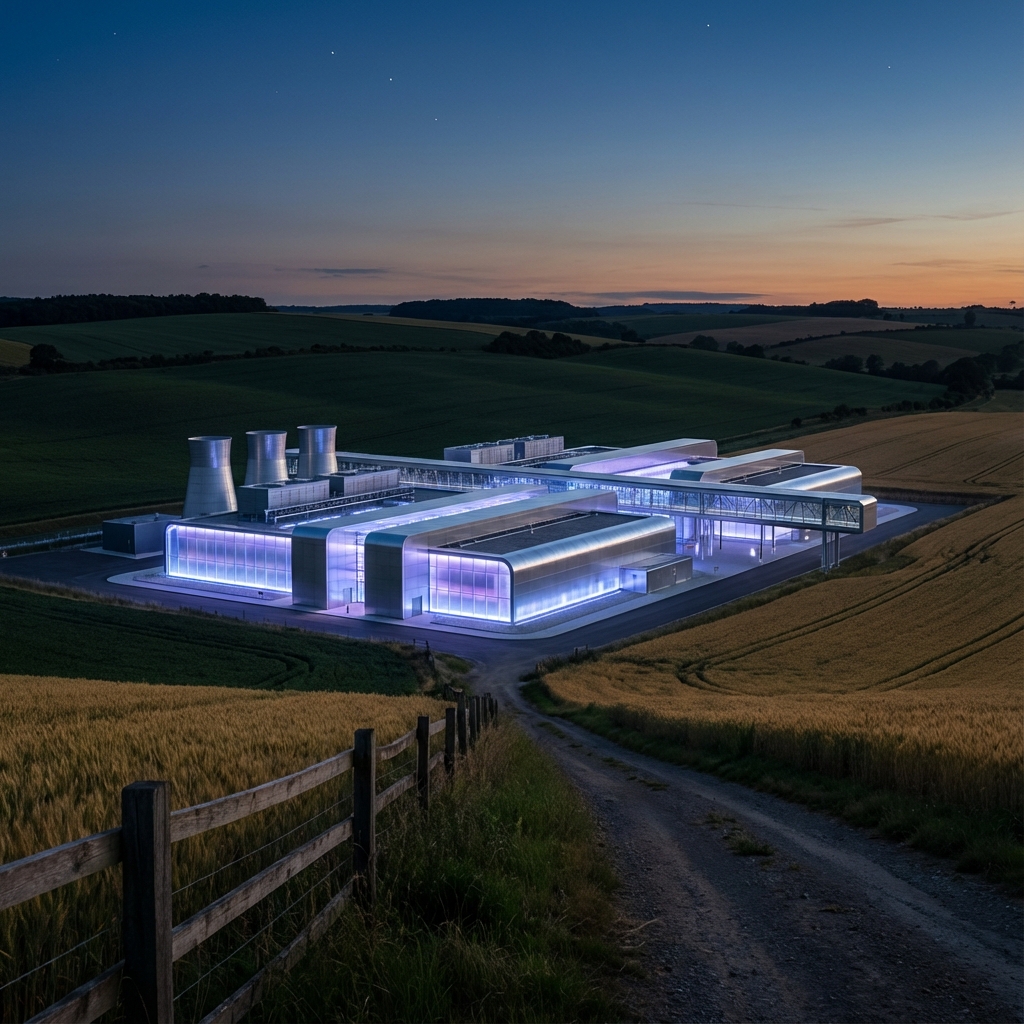
Tiling the Earth: The physical footprint of the intelligence economy requires gigawatt-scale infrastructure.
The Physics of Intelligence: Energy and Space
If energy is the bottleneck, then Earth might be too small a room. The plummeting cost of launch—driven by reusable rockets like Starship—is transforming space from a frontier of exploration into a frontier of extraction.
With launch costs approaching $100/kg and potentially dropping to cents/kg with mass drivers, the economic logic of the solar system changes. We are moving toward a future where heavy industry and energy generation (via solar arrays or fusion) can be offloaded from the biosphere. The “disassembly” of the asteroid belt or the moon is no longer science fiction; it is the logical endpoint of a civilization that requires infinite energy to fuel infinite compute.
The Human Interface: Bandwidth as the Final Bottleneck
As our machines think faster, the bandwidth between us and them remains stubbornly low—limited to the speed of typing or speaking. This is why the progress of companies like Paradromics is critical.
With successful sheep trials and the commencement of human trials in 2025 , we are seeing data transfer rates that dwarf previous standards (200 bits per second vs. 10). This trajectory aligns with the prediction of high-bandwidth Brain-Computer Interfaces (BCI) by the early 2030s.
If AI is the “exocortex,” BCI is the bus that connects it to the neocortex. In a world of superintelligent agents, the only way for humans to remain economically and intellectually relevant may be to merge with the substrate. We are approaching a point where the distinction between “biological thought” and “digital inference” blurs, allowing us to offload memory and processing just as we currently offload navigation to GPS.
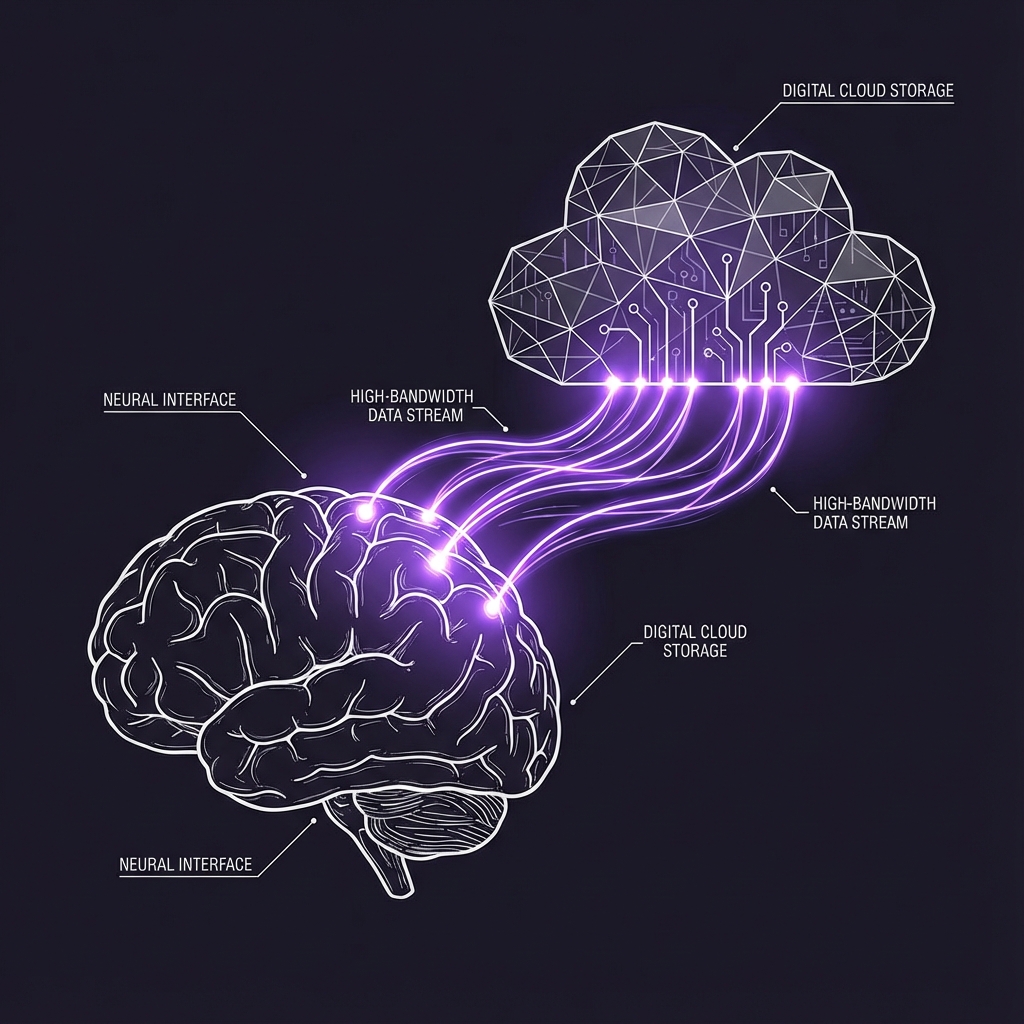
The Bandwidth Problem: Merging biological thought with digital inference via next-gen BCI.
Why It Matters: The One-Way Door
We have walked through a one-way door. There is no returning to a pre-AI scientific method or a pre-agentic economy. The Genesis Mission and Claude Opus 4.5 are not just news items; they are the foundational documents of a new social contract.
The risks are real—from the displacement of labor to the centralization of power in those who control the “compute factories.” But the opportunity is the greatest moonshot of all: to solve the hard problems of existence—disease, energy, scarcity—by applying the universal solvent of intelligence. The Thanksgiving of 2035 will look very different from today’s, not because the turkey has changed, but because the civilization sitting at the table will have finally learned to compute its own destiny.
I take on a small number of AI insights projects (think product or market research) each quarter. If you are working on something meaningful, lets talk. Subscribe or comment if this added value.
Appendices
Glossary
- Genesis Mission: A US government initiative (Executive Order, Nov 2025) led by the DOE to integrate federal scientific datasets and supercomputers to accelerate AI-driven discovery.
- Recursive Self-Improvement: A theoretical and practical threshold where an AI system is capable of writing code to improve its own performance or create better versions of itself, leading to exponential capability growth.
- TPU (Tensor Processing Unit): An AI accelerator application-specific integrated circuit (ASIC) developed by Google. The 'Ironwood' generation represents the 7th iteration, optimized for inference and large-scale training.
Contrarian Views
- The 'Empty Land' Fallacy: While technology makes remote land habitable, the social and logistical friction of relocating populations to 'empty' areas (or space) is often underestimated compared to the ease of digital migration.
- The Bureaucratic Bottleneck: Skeptics argue that even with AI, the 'Genesis Mission' may be stifled by government procurement processes and lack of agility compared to private labs.
Limitations
- Energy Constraints: The article assumes energy production (fusion/solar) will scale to meet the 2.2GW+ demands of new data centers; if energy lags, compute prices will spike.
- Verification of Future Context: This analysis is based on the specific 'future scenario' context provided in the source material (dated late 2025) and treats these events as current facts.
Further Reading
- The Zero Marginal Cost Society - https://www.palgrave.com/gp/book/9781137278463
- Accelerando (Charles Stross) - https://www.antipope.org/charlie/blog-static/fiction/accelerando/accelerando-intro.html
References
- Executive Order: Launching the Genesis Mission - The White House (gov, 2025-11-24) https://www.whitehouse.gov/briefing-room/presidential-actions/2025/11/24/executive-order-genesis-mission/ -> Establishes the national AI-for-science initiative.
- Energy Department Launches 'Genesis Mission' to Transform American Science - U.S. Department of Energy (gov, 2025-11-25) https://www.energy.gov/articles/energy-department-launches-genesis-mission -> Details the implementation of the mission and the goal to double productivity.
- Introducing Claude Opus 4.5 - Anthropic (org, 2025-11-24) https://www.anthropic.com/news/claude-opus-4-5 -> Verifies the release, token efficiency, and coding capabilities of the new model.
- Ironwood: The first Google TPU for the age of inference - Google Cloud Blog (org, 2025-11-06) https://blog.google/products/google-cloud/ironwood-tpu-inference/ -> Confirms the specs and release of the 7th generation TPU.
- Paradromics starts FDA‑approved BCI trials - Paradromics / ChosunBiz (news, 2025-06-05) https://www.paradromics.com/news/human-trials-2025 -> Verifies the progress of BCI trials in sheep and humans.
- Emergency Pod: Genesis Mission, Claude 4.5 & The Future of Science - Moonshots Podcast (video, 2025-11-28) https://www.youtube.com/watch?v=moonshots-ep-2025 -> The primary transcript source discussing the synthesis of these events.
- AI Agent Benchmarks and Data - Qualz.ai (dataset, 2025-11-01) https://qualz.ai -> Provides context on the rapid improvement of agentic performance in coding and economic tasks.
Recommended Resources
- Signal and Intent: A publication that decodes the timeless human intent behind today's technological signal.
- Thesis Strategies: Strategic research excellence — delivering consulting-grade qualitative synthesis for M&A and due diligence at AI speed.
- Blue Lens Research: AI-powered patient research platform for healthcare, ensuring compliance and deep, actionable insights.
- Outcomes Atlas: Your Atlas to Outcomes — mapping impact and gathering beneficiary feedback for nonprofits to scale without adding staff.
- Qualz.ai: Transforming qualitative research with an AI co-pilot designed to streamline data collection and analysis.