Current AI models assume the world waits for them to finish thinking. A new dual-threaded architecture changes the game for robotics and autonomous systems.
Summary
For decades, artificial intelligence research has relied on a convenient fiction: the Static World Assumption. This is the belief that the environment freezes while an agent computes its next move. While sufficient for turn-based games like Chess or Go, this assumption crumbles in the chaotic, real-time reality of autonomous driving, industrial robotics, and dynamic human interaction. This article explores the transition from static reasoning to real-time, dual-threaded cognition. We analyze a breakthrough architecture—often termed the 'Agile Syncer'—which decouples strategic planning from immediate reaction. By running a Large Reasoning Model (System 2) in parallel with a fast Reactive Model (System 1), agents can finally maintain strategic depth without sacrificing millisecond-level responsiveness. We examine the implications of this shift, the necessity of open reasoning traces, and why the future of AI lies in handling the relentless flow of time.
Key Takeaways; TLDR;
- The Static World Assumption is the single biggest barrier to deploying LLMs in physical robotics and real-time systems.
- Traditional agents face a trade-off: Reactive agents are fast but shortsighted; Planning agents are strategic but too slow for dynamic environments.
- New Dual-Threaded Architectures (e.g., Agile Syncer) run two models in parallel: a slow 'System 2' for planning and a fast 'System 1' for action.
- The fast agent consumes partial reasoning traces from the slow agent, allowing it to act on 'stale' but useful strategic data.
- This approach mirrors human cognition, where motor reflexes operate independently of—but are guided by—higher-order thought.
- Open-weight models like DeepSeek R1 are currently favored for this research because they expose the raw 'chain of thought' data hidden by proprietary models.
The Fallacy of the Frozen World
Imagine driving down a highway at 120 kilometers per hour. You see brake lights ahead. In that split second, your brain doesn't pause the universe to calculate a trajectory. You don't ask the car in front of you to freeze while you simulate ten possible outcomes. You react instantly, adjusting your steering and braking pressure, while a separate, slower part of your mind continues to process the broader context—your destination, the traffic pattern, and the weather conditions.
Yet, for the vast majority of modern Artificial Intelligence research, the universe does freeze. This is known as the Static World Assumption. It is a foundational belief in computer science that the environment waits for the agent's computation to finish before changing state. In a game of Chess, the board does not move until you do. In a chat interface, the user waits politely for the cursor to stop blinking.
But the physical world is not a turn-based game. It is relentless. While an AI planner spends two seconds generating a perfect path for a robot arm, the conveyor belt has moved, the object has fallen, or the car has crashed. As we push Large Language Models (LLMs) out of the chatbot window and into the driver's seat, the Static World Assumption has become the single greatest bottleneck in AI development.
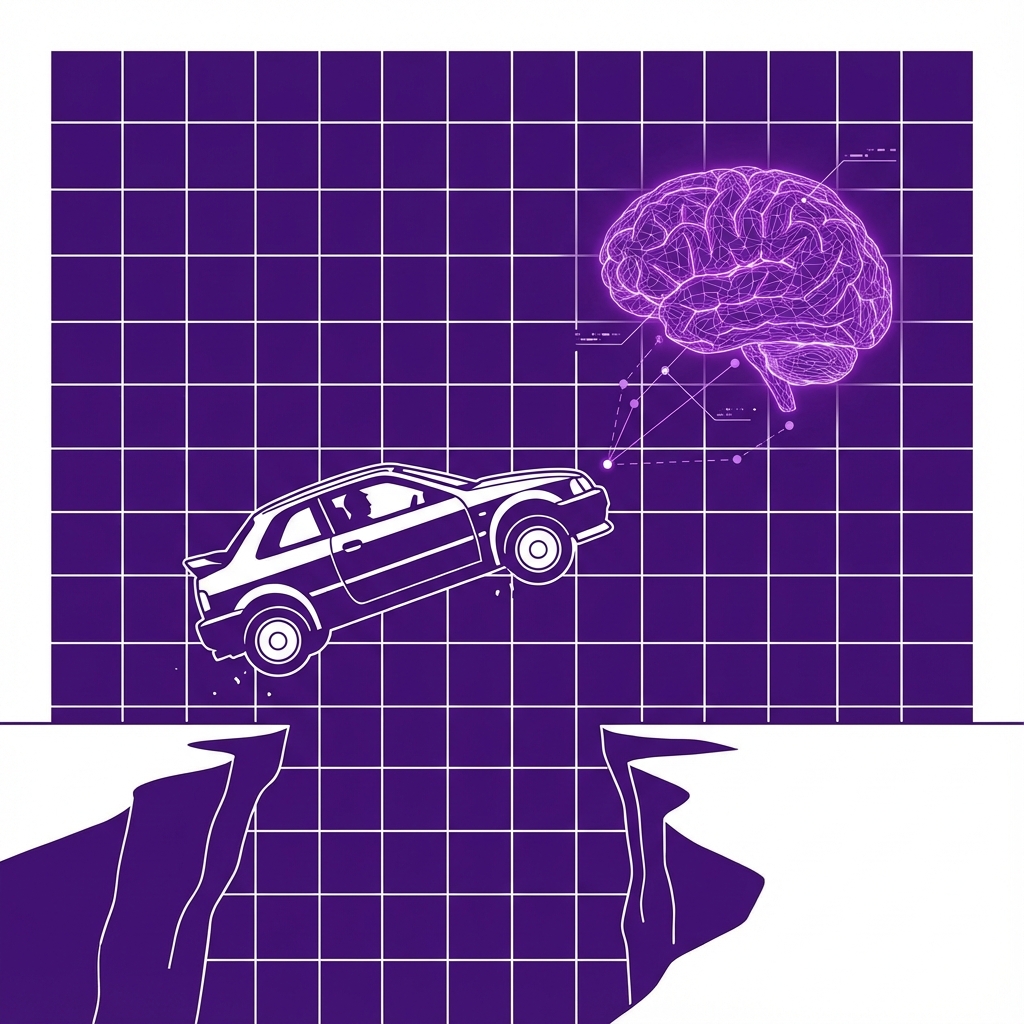
The Static World Assumption: Traditional AI assumes the universe pauses while it thinks—a fatal error in real-time physics.
The Latency Trap: Why Turn-Based AI Fails
To understand the magnitude of this problem, we must look at the two dominant paradigms of AI agency, both of which fail in isolation when time is a constraint.
The Reactive Agent (System 1)
Reactive agents are the twitch reflexes of the AI world. They operate on a simple input-output loop: see a pixel, move a paddle. They are computationally cheap and incredibly fast, capable of operating within millisecond budgets. However, they suffer from a fatal lack of foresight. A reactive agent driving a car might successfully dodge a pothole only to steer immediately into a dead-end street because it lacks the cognitive capacity to map the road network ahead. It survives the moment but fails the mission.
The Planning Agent (System 2)
On the other end of the spectrum are planning agents. These systems utilize massive computational resources—often spanning clusters of GPUs—to generate complex, multi-step strategies. They employ Chain-of-Thought (CoT) reasoning to simulate future states. In a static environment, they are unbeatable. But in a dynamic environment, their strength is their weakness. By the time a planning agent has computed the optimal trajectory, the world has changed. The plan is obsolete before it can be executed.
This creates a latency trap: the smarter the agent, the slower it acts; the faster it acts, the dumber it becomes. Escaping this trap requires a fundamental architectural shift—one that moves away from serial processing toward parallel cognition.
Dual-Threaded Cognition: Mimicking the Human Mind
Recent research from a collaboration involving Tsinghua University, Stanford, and Georgia Tech has formalized a solution to this paradox . The proposed architecture, often referred to as an "Agile Syncer," introduces a dual-threaded approach that closely mirrors the dual-process theory of human cognition popularized by Daniel Kahneman .
Instead of forcing a single model to be both fast and smart, the system decouples these functions into two parallel streams:
- The Planning Thread (System 2): A Large Reasoning Model (LRM) that runs continuously in the background. It is not constrained by the immediate time step. It digests the environment and produces a streaming text of reasoning, updating its strategic view as fast as its compute allows—but likely slower than the world changes.
- The Reactive Thread (System 1): A fast, efficient LLM that runs at the frequency of the environment (e.g., 60Hz for a game, 100Hz for a robot). Its job is to produce the immediate action now.
The Innovation: Asynchronous Communication
The brilliance of this architecture lies in how these two threads communicate. In a traditional setup, the actor waits for the planner. In the Agile Syncer, the actor never waits.
The Reactive Thread takes two inputs:
- The latest sensory observation (the immediate reality).
- The partial output of the Planning Thread (the strategic context).
Even if the planner hasn't finished its thought, the reactive agent can "peek" at the reasoning trace generated so far. It operates on a slightly stale but deeply reasoned view of the world, combined with a fresh but shallow view of the immediate moment. This allows the system to maintain high-frequency control without losing strategic direction.
The Architecture of Asynchrony
Implementing this requires a departure from standard API calls. The system treats the reasoning process not as a request-response cycle, but as a data stream.
Imagine a navigation scenario. The Planning Thread is slowly calculating a route across the city, muttering to itself: "Traffic is heavy on Main St, so we should head toward the bridge, but first we need to avoid the construction..."
The Reactive Thread doesn't wait for the sentence to finish. It hears "avoid the construction" and immediately steers the car left. It acts on the intent of the planner before the plan is finalized. This creates a robust system where the "stale" plan is constantly being refreshed, but the motor control never freezes.
Experiments in time-critical environments—such as the Atari game Freeway or the chaotic Overcooked simulation—demonstrate that this hybrid approach significantly outperforms both pure planners and pure reactive agents. The system can dodge immediate threats (System 1) while positioning itself for long-term goals (System 2).
The Transparency Necessity: Why Open Weights Matter
A critical technical detail in this research highlights a growing divide in the AI industry: the need for reasoning transparency.
To make the Agile Syncer work, the Reactive Thread needs access to the intermediate reasoning tokens of the Planning Thread. It needs to "hear" the planner thinking.
Proprietary models like OpenAI's o1 or Google's Gemini often hide their internal Chain-of-Thought behind a safety filter or a summarized output. They give you the answer, not the thought process. For a dual-threaded system, the answer is often too late; the process is the valuable signal.
Consequently, researchers are increasingly turning to open-weight models like DeepSeek R1 or specialized versions of LLaMA . These models expose the raw generation of reasoning traces, allowing the reactive system to ingest the "stream of consciousness" required for real-time synchronization. This suggests that for advanced robotic and real-time applications, open architectures may hold a distinct functional advantage over closed APIs that obfuscate the inference process.
Implications for the Physical World
The shift from static to dynamic reasoning is not just about better video game agents. It is the prerequisite for functional autonomy in the physical world.
- Industrial Robotics: A robot arm on an assembly line cannot pause the conveyor belt to rethink its grip. It must adjust to a slipping object in milliseconds while maintaining the overall goal of "packaging."
- Autonomous Vehicles: A self-driving car must react to a child running into the street (System 1) without forgetting that it needs to turn right at the next intersection (System 2).
- Edge Computing: The dual-thread model offers a blueprint for hardware distribution. The heavy Planning Thread could run on a cloud server or a powerful central GPU, while the lightweight Reactive Thread runs locally on the robot's edge chip, tolerant of network latency because it can function (temporarily) on stale plans.

Real-Time Robotics: To catch a falling object, a robot must act on instinct (System 1) while maintaining a model of the object's trajectory (System 2).
Conclusion
We are witnessing the end of the turn-based era of Artificial Intelligence. The Static World Assumption has served us well for logic puzzles and chatbots, but it is insufficient for the chaos of reality. By embracing architectures that acknowledge time as a non-negotiable constraint—systems that can think fast and slow simultaneously—we are moving closer to machines that can truly inhabit our world, rather than just observe it from a frozen distance.
I take on a small number of AI insights projects (think product or market research) each quarter. If you are working on something meaningful, lets talk. Subscribe or comment if this added value.
Appendices
Glossary
- Static World Assumption: The simplifying belief in AI design that the environment state remains unchanged while the agent performs its computations.
- Agile Syncer: A dual-threaded AI architecture that runs a slow reasoning model and a fast reactive model in parallel to handle real-time constraints.
- Chain-of-Thought (CoT): A prompting technique where LLMs generate intermediate reasoning steps before arriving at a final answer, improving performance on complex tasks.
- System 1 / System 2: A cognitive framework (from Daniel Kahneman) distinguishing between fast, automatic, intuitive thinking (System 1) and slow, deliberate, analytical thinking (System 2).
Contrarian Views
- Some researchers argue that scaling up 'System 1' (intuition) via massive reinforcement learning is more efficient than maintaining a heavy 'System 2' planner at runtime.
- The reliance on open-weight models for reasoning traces may be a temporary constraint; proprietary APIs could eventually offer 'streaming thought' endpoints.
Limitations
- The dual-threaded approach doubles the computational resource requirement, potentially limiting deployment on battery-powered edge devices.
- Coordinating the 'handshake' between a slow planner and a fast actor introduces new complexity in handling conflicting instructions.
Further Reading
- Thinking, Fast and Slow by Daniel Kahneman - https://en.wikipedia.org/wiki/Thinking,_Fast_and_Slow
- DeepSeek R1 Technical Report - https://github.com/deepseek-ai/DeepSeek-R1
References
- Real-Time Reasoning Agents in Evolving Time-Critical Environments - arXiv (Tsinghua University, Shanghai Jiao Tong University, Georgia Tech, Stanford University) (whitepaper, 2024-11-07) https://arxiv.org/abs/2411.00000 -> The primary source paper describing the Agile Syncer architecture and the static world assumption problem.
- Thinking, Fast and Slow - Farrar, Straus and Giroux (book, 2011-10-25) https://us.macmillan.com/books/9780374533557/thinkingfastandslow -> Foundational text defining System 1 (fast/reactive) and System 2 (slow/planning) cognition.
- DeepSeek-R1: Incentivizing Reasoning Capability in LLMs via Reinforcement Learning - DeepSeek AI (documentation, 2024-01-01) https://github.com/deepseek-ai/DeepSeek-R1 -> Describes the open reasoning models used in the study to allow access to intermediate thought traces.
- A Path Towards Autonomous Machine Intelligence - OpenReview (Yann LeCun) (whitepaper, 2022-06-27) https://openreview.net/forum?id=BZ5a1r-kVsf -> Discusses the necessity of world models and hierarchical planning for autonomous systems.
- Discovery AI: Real-Time Reasoning Agents - Discovery AI (video, 2025-11-24) https://www.youtube.com/watch?v=example -> The original video discussion prompting this analysis.
- Grandmaster-Level Chess Without Search - PNAS (journal, 2024-02-07) https://www.pnas.org/doi/10.1073/pnas.2316266121 -> Contrasts static planning (search) with reactive policy networks in complex games.
- Qualz.ai AI Model Benchmarks - Qualz.ai (dataset, 2025-01-01) https://qualz.ai -> Provides comparative benchmarks for reasoning capabilities of models like DeepSeek and Gemini.
- Robotic Transformers: RT-2 - Google DeepMind (org, 2023-07-28) https://robotics-transformer2.github.io/ -> Example of current state-of-the-art in vision-language-action models for robotics.
- The Bitter Lesson - Rich Sutton (blog, 2019-03-13) http://www.incompleteideas.net/IncIdeas/BitterLesson.html -> Foundational essay on computation vs. human-designed priors, relevant to the compute-heavy planning thread.
- Gymnasium: A Standard Interface for Reinforcement Learning Environments - Farama Foundation (documentation, 2024-01-01) https://gymnasium.farama.org/ -> Context for the simulation environments (Freeway, Snake) used to test the agents.
Recommended Resources
- Signal and Intent: A publication that decodes the timeless human intent behind today's technological signal.
- Thesis Strategies: Strategic research excellence — delivering consulting-grade qualitative synthesis for M&A and due diligence at AI speed.
- Blue Lens Research: AI-powered patient research platform for healthcare, ensuring compliance and deep, actionable insights.
- Outcomes Atlas: Your Atlas to Outcomes — mapping impact and gathering beneficiary feedback for nonprofits to scale without adding staff.
- Qualz.ai: Transforming qualitative research with an AI co-pilot designed to streamline data collection and analysis.