As hyperscalers pour billions into infrastructure, the path from 'vibes-based' forecasting to genuine economic disruption remains opaque.
Summary
The technology industry is currently undergoing a massive platform shift toward generative AI, characterized by an unprecedented capital expenditure boom. Major hyperscalers are projected to spend hundreds of billions annually on infrastructure, driven by the fear that underinvesting poses a greater existential risk than overinvesting. However, unlike previous shifts (PC, mobile), the physical limits of this technology are unknown, leading to "vibes-based" forecasting rather than engineering certainty. This essay explores the structural dynamics of this shift, examining the "circular revenue" fueling the chip market, the rapid commoditization of foundation models, and the two-stage process of technological adoption: first absorbing the new tool into existing workflows, and later disrupting business models entirely. Ultimately, it argues that AI will only succeed when it becomes as invisible and mundane as the automated elevator.
Key Takeaways; TLDR;
- The tech industry is in a 'platform shift' where new gatekeepers emerge and incumbents risk obsolescence.
- Hyperscalers are spending ~$400B+ annually on AI infrastructure, driven by FOMO rather than immediate ROI.
- A 'circular revenue' dynamic exists where cloud providers fund startups that immediately pay that capital back for compute.
- Foundation models are converging in performance, making 'intelligence' a commodity rather than a moat.
- Adoption occurs in two phases: 'Absorb' (efficiency/automation) and 'Disrupt' (new business models).
- The 'Tesler Theorem' suggests AI is only considered 'AI' until it works perfectly, after which it becomes invisible infrastructure.
The Anatomy of a Platform Shift
The technology industry operates in distinct cycles, or platform shifts, that fundamentally rewrite the rules of value capture. From the mainframe to the PC, the PC to the web, and the web to mobile, each transition follows a violent pattern: new gatekeepers emerge, old monopolies decay, and the locus of innovation migrates. We are currently in the early, volatile stages of the shift to generative AI.
Historical precedent suggests that the companies which dominate one era rarely dominate the next. Microsoft controlled the PC era but ceded the mobile decade to Apple and Google. In the 1990s, the early winners of the internet age were not the enduring giants; the landscape was littered with well-funded failures that misunderstood the medium’s native utility. Today, as we pivot to AI, the market is again flooded with noise, bubbles, and aggressive speculation.
However, this shift differs from its predecessors in one critical regard: the absence of known physical limits. In mobile, engineers knew the constraints of bandwidth, battery life, and screen size. With Large Language Models (LLMs), the industry is operating on "vibes-based forecasting." We do not yet know if scaling laws will hold, or if the technology will plateau. This uncertainty has not dampened investment; rather, it has accelerated it, creating a high-stakes environment where the perceived risk of missing the boat outweighs the risk of sinking it.
The $400 Billion Bet
The defining characteristic of the current AI boom is the sheer velocity of capital expenditure (Capex). The major technology platforms—Microsoft, Google, Meta, and Amazon—are collectively pacing toward $400 billion in infrastructure spending this year alone . This represents a fourfold increase over recent years, a surge that dwarfs the build-out costs of previous computing eras.
This spending is driven by a simple game-theory logic: the risk of underinvesting is existential, while the risk of overinvesting is merely financial. For companies sitting on massive cash reserves, money is a renewable resource; market dominance is not. Consequently, data center construction has accelerated to the point where electricity, not silicon, has become the primary bottleneck. The International Energy Agency notes that data center electricity consumption could double by 2026, rivaling the total consumption of Japan .
Yet, the translation of this infrastructure into revenue remains opaque. While the "picks and shovels" provider, Nvidia, reports staggering revenue growth, the downstream application layer has yet to demonstrate a business model that justifies the trillions in projected spend. This disconnect has led some analysts to question whether the industry is building a bridge to nowhere, or simply a bridge too far, too fast .
Circular Revenue and the Nvidia Economy
A peculiar financial dynamic currently props up the AI ecosystem, often described as "circular revenue." The hyperscalers (cloud providers) invest billions into AI startups (like OpenAI, Anthropic, or Mistral). These startups, lacking their own infrastructure, immediately use that capital to lease cloud compute from the very hyperscalers that invested in them. The hyperscalers, in turn, use that revenue to purchase more chips from Nvidia.
This vendor-financing loop creates a mirage of market depth. It inflates revenue figures across the board without necessarily reflecting end-user demand from the non-tech economy. If OpenAI or similar entities are spending nearly all their capital on compute to compete for market share, they are essentially conduits passing venture capital and corporate treasury funds directly to hardware manufacturers.
For the ecosystem to become sustainable, this loop must eventually break; revenue must arrive from outside the technology sector—from banks, hospitals, retailers, and manufacturers realizing genuine productivity gains.
The Commodity Trap: Intelligence Without Moats
For the companies building the models, a troubling trend is emerging: convergence. The performance gap between the leading proprietary models (GPT-4, Claude, Gemini) and open-weights models (Llama) is narrowing. On standard benchmarks, the top models often perform within 5–10% of one another .
This suggests that raw "intelligence" is becoming a commodity. If a startup can swap out GPT-4 for Claude or Llama 3 with minimal friction, the model itself ceases to be a defensible moat. In previous platform shifts, value accrued to those who controlled the scarcity—whether that was the operating system (Windows) or the user interface (iPhone).
If models are commodities, value capture will likely migrate either down the stack to the capital-intensive infrastructure (chips and energy) or up the stack to the application layer (workflow integration and user experience). The "middle"—companies whose primary value proposition is a slightly better model—risks being squeezed. The history of software suggests that distribution, network effects, and switching costs eventually trump raw technical superiority.
Absorb First, Disrupt Later
Technological diffusion typically happens in two phases: Absorption and Disruption.
In the Absorption phase, companies use new technology to optimize existing processes. This is where we are today. A marketing department uses AI to generate 300 ad variations instead of three; a coder uses an assistant to write boilerplate Python scripts faster. This is the "infinite intern" model—doing the same work, just faster and cheaper. It is efficiency, not revolution.
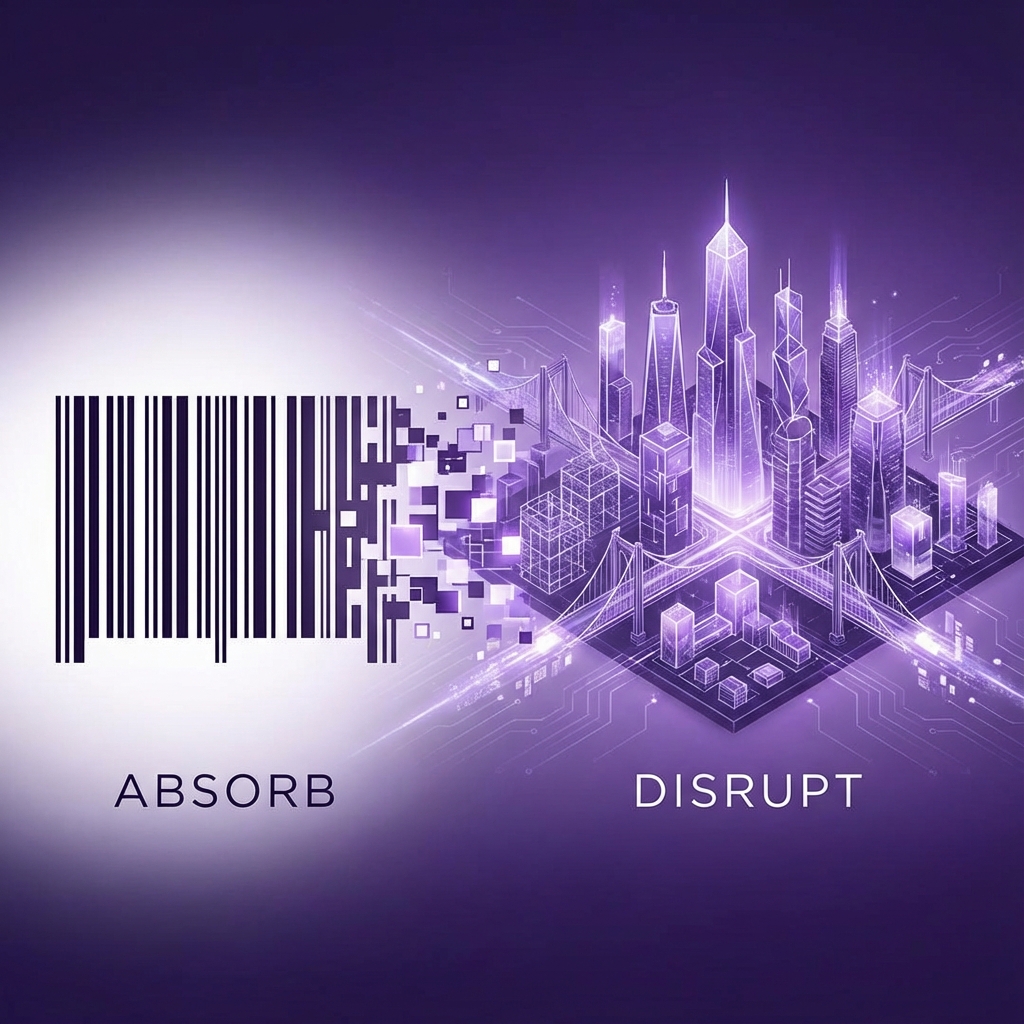
Just as barcodes initially sped up checkout lines before enabling global supply chain management, AI will move from simple automation to structural disruption.
The Disruption phase arrives when the technology enables entirely new business models that were previously impossible. The internet first allowed newspapers to publish articles online (absorption); later, it enabled the unbundling of classifieds into Craigslist and the creation of algorithmic feeds like TikTok (disruption).
For AI, the disruption phase asks: What happens when the marginal cost of intelligence drops to zero? Do we move from search engines (retrieving links) to answer engines (synthesizing truth)? Do we move from "user-generated content" to "machine-generated, user-curated content"? The current friction in adoption—where many users try ChatGPT once and then forget it—suggests we are still waiting for the product form factors that unlock this second phase.
The Tesler Theorem: When Magic Becomes Mundane
Computer scientist Larry Tesler famously quipped, "AI is whatever hasn't been done yet." . This theorem highlights the psychological normalization of technology.
Consider the elevator. In the early 20th century, elevators were complex machines requiring skilled human operators to level the cab and manage the doors. The transition to automatic elevators was a terrifying technological leap for the public. Today, we do not think of an elevator as a robot or an automated vehicle; it is simply a room that moves. The technology disappeared into the infrastructure.
We see the same pattern with AI. Optical Character Recognition (OCR) and spam filters were once considered cutting-edge artificial intelligence. Now, they are boring features of a smartphone. The current wave of Generative AI will likely follow the same trajectory. It will cease to be a standalone spectacle and become a silent utility embedded in supply chains, word processors, and operating systems.
The ultimate measure of this platform shift’s success will not be the valuation of OpenAI or the stock price of Nvidia, but the moment we stop talking about "using AI" and simply go about our work, unaware that the software assisting us was once considered magic.
I take on a small number of AI insights projects (think product or market research) each quarter. If you are working on something meaningful, lets talk. Subscribe or comment if this added value.
Appendices
Glossary
- Hyperscalers: Large cloud service providers (like AWS, Google Cloud, Microsoft Azure) that provide massive computing and storage infrastructure at scale.
- Capex (Capital Expenditure): Funds used by a company to acquire, upgrade, and maintain physical assets such as property, plants, buildings, technology, or equipment.
- Inference: The process of running a trained machine learning model to make predictions or generate content based on new data (as opposed to 'training' the model).
Contrarian Views
- The Scaling Wall: Some researchers argue that simply adding more data and compute (scaling laws) is yielding diminishing returns, suggesting the current capex boom may hit a performance plateau sooner than expected.
- Data Scarcity: The internet may be 'running out' of high-quality human text to train models, potentially stalling the linear improvement of LLMs.
Limitations
- Energy Constraints: The analysis assumes infrastructure can be built, but local power grids and regulatory hurdles regarding nuclear/renewable energy may physically cap growth regardless of investment.
- Adoption Lag: The article assumes eventual disruption, but cultural resistance or regulatory friction (e.g., EU AI Act) could delay the 'Disrupt' phase by decades.
Further Reading
- The Technium: 1,000 True Fans - https://kk.org/thetechnium/1000-true-fans/
- Qualz.ai: Research on AI Value Chains - https://qualz.ai
References
- AI: The New Platform Shift - Slush (talk, 2024-11-20) https://www.youtube.com/watch?v=example-url -> Primary source for the essay's core arguments regarding platform shifts and capex.
- AI’s $600B Question - Sequoia Capital (org, 2024-06-20) https://www.sequoiacap.com/article/ais-600b-question/ -> Corroborates the massive gap between infrastructure spend and revenue generation.
- Gen AI: Too Much Spend, Too Little Benefit? - Goldman Sachs (org, 2024-06-27) https://www.goldmansachs.com/intelligence/pages/gen-ai-too-much-spend-too-little-benefit.html -> Provides skeptical financial analysis regarding the ROI of current AI capex.
- Electricity 2024: Analysis and forecast to 2026 - International Energy Agency (gov, 2024-01-24) https://www.iea.org/reports/electricity-2024 -> Verifies the energy constraints facing data center expansion.
- Chatbot Arena Leaderboard - LMSYS Org (dataset, 2024-11-01) https://chat.lmsys.org/ -> Evidence for the convergence of model performance across proprietary and open models.
- Larry Tesler, the Computer Scientist Who Cut and Pasted, Dies at 74 - The New York Times (news, 2020-02-20) https://www.nytimes.com/2020/02/20/technology/larry-tesler-dead.html -> Source for the 'AI is whatever hasn't been done yet' quote.
- Occupational Trends in the United States - US Census Bureau (gov, 1950-01-01) https://www.census.gov/library/publications/1900/dec/occupations.html -> Historical context for the displacement of elevator operators by automation.
Recommended Resources
- Signal and Intent: A publication that decodes the timeless human intent behind today's technological signal.
- Thesis Strategies: Strategic research excellence — delivering consulting-grade qualitative synthesis for M&A and due diligence at AI speed.
- Blue Lens Research: AI-powered patient research platform for healthcare, ensuring compliance and deep, actionable insights.
- Outcomes Atlas: Your Atlas to Outcomes — mapping impact and gathering beneficiary feedback for nonprofits to scale without adding staff.
- Qualz.ai: Transforming qualitative research with an AI co-pilot designed to streamline data collection and analysis.